
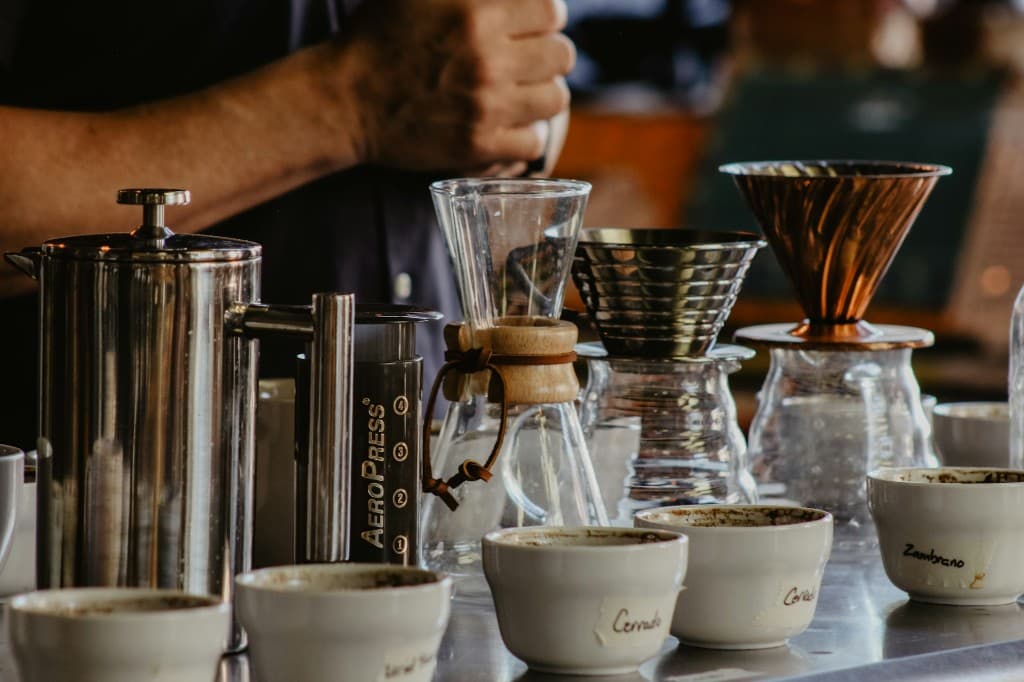
Every brewer is a controlled way to combine coffee grounds, water, time, and temperature. The big split is percolation (water drips or flows through a bed) versus immersion (grounds steep in water, then you separate them). Hybrid brewers like the AeroPress borrow from both.
Percolation: pour-over and flat-bottom drippers
In pour-over, you’re managing how fast water drains through the coffee bed. Finer grind and slower pours generally increase contact time and extraction; coarser grind and faster flow do the opposite. That’s why two people with the “same” 1:16 ratio can get wildly different cups — time in contact matters as much as the number on the scale.
Cone drippers (like the V60) often reward a little more attention to pour pattern and grind. Flat-bottom brewers (like the Kalita Wave) can be a bit more forgiving on evenness because the bed depth and drainage pattern differ. Neither is “better”; they’re different geometries that change how water flows.
The Chemex uses a thicker filter, which pulls more oils and fines out of the cup. You’ll often taste a cleaner, lighter body than a V60 with a thin filter — same idea, different clarity.
Immersion: press and steep
French press is full immersion: all the coffee and all the water hang out together for the whole brew. You typically want a coarser grind than pour-over so you don’t over-extract on the long steep, unless you deliberately break crust and agitate (which speeds extraction).
Cup-style brewers where coffee steeps and then drains through a filter (Clever, some batch brewer baskets in manual mode) behave like immersion up until the drawdown; treat the grind more like immersion until you learn how fast your drawdown runs.
AeroPress and other hybrids
The AeroPress can be inverted (full immersion) or upright with some percolation during the press. Competitions and cafe recipes prove there’s no single right recipe — there’s only a loop: brew, taste, change one variable, repeat.
Ratios as a starting line, not a rule
A common starting range is 1:15 to 1:17 coffee to water by weight (for example 20g coffee to 300–340g water). Lighter roasts often carry more dissolved solids locked in the bean; some people prefer a slightly higher ratio (more water) to open up sweetness. Darker roasts can go lower ratio if you want more intensity without stretching extraction time.
Dial in by taste (the cheat sheet)
- Harsh, dry, or overly bitter? You likely pushed extraction too far — try a coarser grind, cooler water, or a shorter brew time (depending on method).
- Sour, thin, or grassy? You’re probably under-extracting — finer grind, hotter water, or longer contact can help.
- Change one thing at a time so you know what moved the cup.
What to read next
Grind is how you actually control contact time in most methods — Grinding ties directly to everything above. Water quality and temperature close the loop on Water & extraction.